INNN Direct Line, hello! Ask me anything about the show
A 1960s rotary phone, an AI that fits on a laptop, and two days at a trade show in Niort.
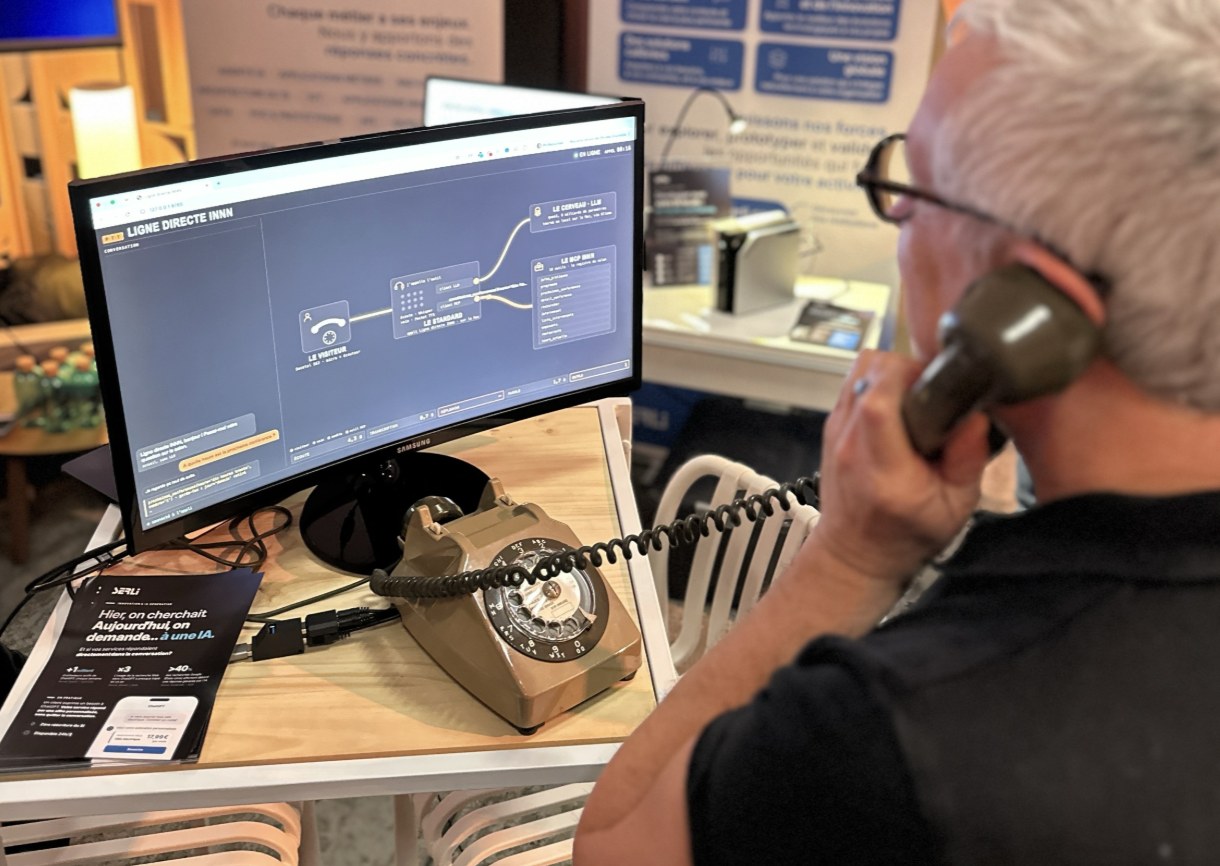
On SERLI’s stand at the INNN show, there was a rotary phone from the 1960s. You pick up the handset, ask your question out loud, and a voice answers in the earpiece.
You could ask it what was on at two o’clock, where to find an exhibitor, who a given speaker was, or even where to have lunch.
On the other end of the line, no operator: an AI that knows the show’s programme and runs entirely locally, on a laptop.
The idea
INNN is the trade show for digital innovation, insurtech and risk, held in Niort, France, on 4 and 5 November. Mathieu Ancelin and I work at SERLI, which had a stand at the show. We were looking for a demo that would make people stop. At an innovation show, everyone shows screens. We wanted to do the opposite.
The idea fits in one sentence: an object everyone knows, for a technology everyone is discovering. Nobody needs a manual to use a telephone. You pick up, you talk, you listen. It is the most natural voice interface there is, and it is more than sixty years old.
We also wanted everything to run locally. Trade show Wi-Fi is rarely reliable, and it was a chance to check a hunch: today, a laptop is enough to run a complete voice assistant, with no cloud.
Bringing a Socotel S63 back to life
Our phone is a Socotel S63, the model installed by the French PTT (the former post and telecoms administration) that many people remember from their grandparents’ homes. We found it on leboncoin, the French classifieds site, in Poitiers, for 20 euros.
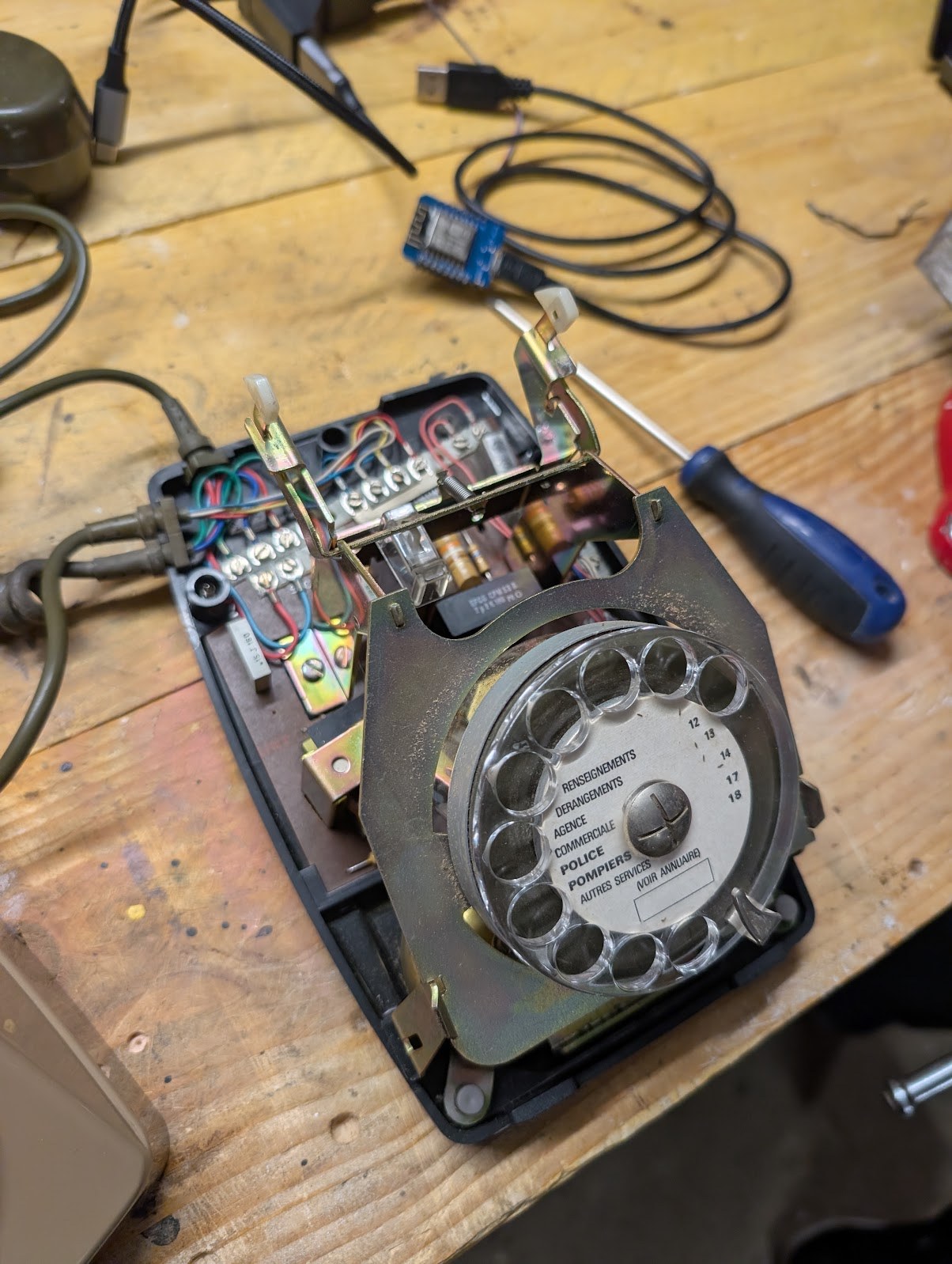
One rule from the start: don’t damage anything. The handset and its cord are original, and everything happens inside the base. The handset’s microphone and earpiece are wired to a small USB sound card.
A microcontroller board costing a few euros, a Wemos D1 mini, watches the hook the handset rests on. It tells the computer when someone picks up or hangs up. A mini USB hub brings it all together, and a single cable comes out of the phone.
For the microphone and earpiece, the wiring was fairly simple: two wires each, to the sound card’s jacks. The multimeter was mostly needed for the hook, to find out which contact blades switch when you pick up and when you hang up.
What happens when you pick up
At the centre is our application. Like a switchboard, it passes the question from one building block to the next.
- The ear. When the visitor has finished speaking (staying silent for a little under a second is enough), their question is transcribed into text by Whisper, OpenAI’s speech recognition model, running directly on the Mac’s chip.
- The brain. The application sends this text to a language model: Qwen3, an open model from Alibaba, in its 8-billion-parameter version, served locally by Ollama.
- The show programme. The model knows nothing about the show. When it needs information, it asks the application to query a server that knows the whole programme: 46 sessions, 104 speakers, 86 exhibitors, practical information and even a selection of nearby restaurants. This data comes from the show’s website.
- The voice. The answer is read out by Pocket TTS, a small speech synthesis model designed by Kyutai, a French lab, with the “Estelle” voice.
The brain never talks to the programme directly. When it needs information, it asks the application to call a tool, and the application reports the result back.
For developers: the programme server speaks MCP (Model Context Protocol), the open protocol for giving tools to a language model. It knows nothing about the phone. It could be plugged into any compatible assistant, and the model could be swapped without touching the data.
The phone itself only relays. The whole thing runs on a MacBook Pro M3 Pro.
What we learned along the way
On the phone, silence is the enemy
In front of a screen, you wait for an answer without even noticing. On the phone, three seconds of silence feel long: you wonder whether the line has dropped.
But Qwen3 is a model that “thinks”: before answering, it writes itself a chain of reasoning that nobody reads. In our first tests, a simple question could take 90 seconds. Once this thinking was switched off, the same answer arrived in 1.5 seconds.
Then we made the phone speak as it goes: the voice starts as soon as the first sentence is written, while the model drafts the rest. Result: the first sentence arrives in about 1.3 seconds, and in 3 seconds when the programme needs to be looked up.
For those few seconds, we did what switchboard operators did: fill the silence. “Please hold, I’m looking.” “Let me check the show’s great register.” These phrases are picked at random and don’t go through the AI. Likewise, when the visitor says “thank you, goodbye”, the phone answers straight away and hangs up, without asking the model anything.
Speaking is not writing
At the first real test, we asked for the day’s programme. The model answered as it would have in a chat window: a ten-line list, read out in one go, without a breath. On a screen, it’s clear. To the ear, it’s incomprehensible.
We had to teach the AI to speak. The programme server now prepares a summary designed to be heard, with an instruction: mention two or three highlights, then offer the details. And the voice pauses briefly between sentences.
Pronunciation took some work too (the phone speaks French). The very name of the show, INNN, was read as a string of letters. A small lexicon turns it into “Inn”, has stand C04 read as “C zéro quatre”, and times are spelled out before being read: “14h30” becomes “quatorze heures et demie” (half past two).
The problem exists the other way round too. To help Whisper, we had given it the show’s name as a hint. Result: it would sometimes transcribe “INNN INNN INNN” in a loop. Now we hint “Inn” instead.
A small model makes things up
Qwen3 is impressive for its size, but it likes to fill in the blanks. On a Wednesday, we ask it “What’s on tonight?”: the model fetches Thursday’s programme. We ask for the next talk: it adds “tomorrow morning” on its own, copied from the example we had put in the tool’s description.
A tool description is a prompt too. And when you search for DARVA’s speakers, a slightly too lenient search answers… Arthur Carvalho.
The fix: don’t expect everything from the model. The code around it checks what it asks for. If it adds a day or a time the visitor never said, we remove them, and the search tries exact names before falling back to approximate matches.
Several of these fixes were made on the stand, on the first day, between two calls.
The retro touches
Since the object is retro, we wanted the experience to be retro too, down to the details.
When you pick up, you first hear the dial tone, just long enough to bring the handset to your ear. During lookups, the AI keeps you waiting like an old-time switchboard operator.
One problem remained: you can’t see a phone at work. So we added a screen next to it, showing live what happens during the call.
On it, you see the visitor and a cord switchboard along which the messages travel. The language model is drawn as a vacuum tube from an old radio, and the programme server as a toolbox whose right drawer opens with each lookup.
On the left, the conversation is shown as bubbles, with the sentence being read highlighted. At the bottom, counters show response times. The icons are drawn in copper-coloured line art: emoji weren’t retro enough. When nobody is calling, the screen replays a demo in a loop.
On the day
Mission accomplished. The phone caught the eye from afar, visitors played along, and on the whole it worked well.
The feedback almost always came back to the same thing: the paradox between modernity and nostalgia. A 1960s phone to talk to an AI makes people smile, then makes them think.
Several visitors also asked for the time, and stumbled on our easter egg. For this question, the phone doesn’t go through the AI: it answers like the French speaking clock. “Au quatrième top, il sera exactement quatorze heures, douze minutes et trente secondes.” (“At the fourth beep, it will be exactly fourteen hours, twelve minutes and thirty seconds.”)
Four beeps follow, the last one right on the announced time. The speaking clock, switched off in 2022, was back in service for the length of a trade show, and the Proust’s madeleine effect worked a treat.
And when something goes wrong during a call, the phone doesn’t hang up on the visitor. It apologises: “Sorry, I had a small technical problem. Could you ask your question again?” We learned to do that the day an error in the time conversion cut off a test call.
Wrapping up
INNN Direct Line was first and foremost a way for us to have fun and bring something original to the show. It’s not a product, it’s a stand demo.
Day to day at SERLI, we build real applications and real MCP servers, like the one behind the MAIF app in ChatGPT. This phone was an original way to show that know-how at a trade show: a language model, an MCP server and an application that makes them work together, hidden inside an object everyone wants to pick up.